
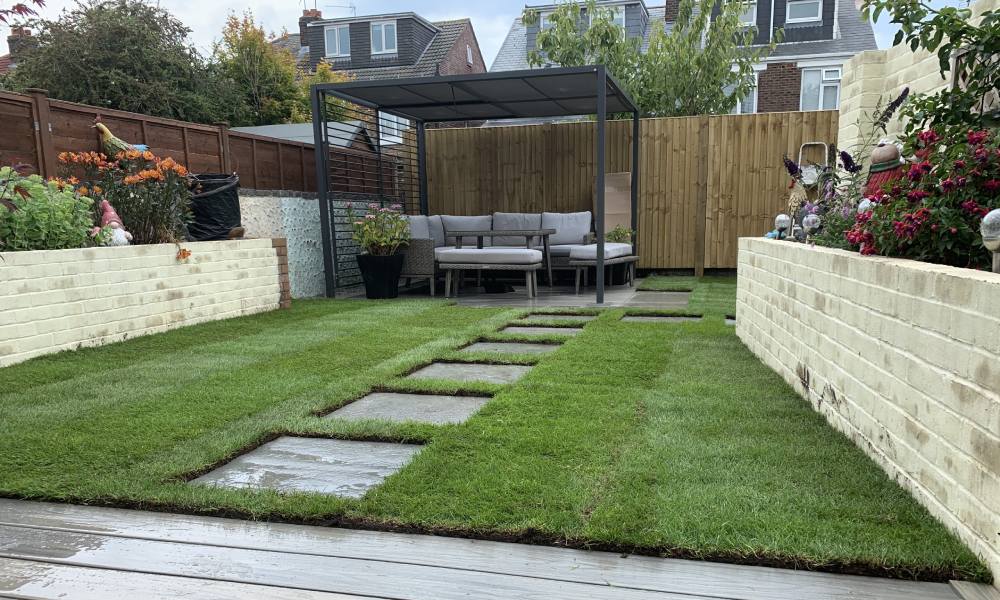
Professional landscaping in Harlow demands specialist drainage design for dense London Clay, sloped plots, and strict 2026 SuDS planning standards. Long-lasting gardens rely on deep Type 1 MOT sub-bases, permeable paving, French drains, and planting schemes designed for year-round resilience.
From the characterful cottages of Old Harlow to the contemporary family homes of Church Langley and Newhall, successful landscaping harlow is never just about appearance it is about engineering gardens that perform beautifully through wet winters, dry summers, and challenging Essex ground conditions.
At Mainline Drives and Patios, we design and build premium outdoor spaces that respect the town’s landscape heritage while meeting modern planning expectations. Whether you need a porcelain patio, SuDS-compliant paving, structural retaining solutions, or a complete garden transformation, every project begins with drainage, levels, and long-term performance.
The Master planned Landscape: Respecting Harlow’s Green Wedge Legacy
Sir Frederick Gibberd did not design Harlow as a town that simply expanded outward. He planned it around nature.
His famous “Green Wedge” philosophy created protected landscape corridors running through residential districts, ensuring homes remained visually and physically connected to the wider Essex countryside. These green wedges still shape the identity of places such as Old Harlow, Katherines, Church Langley, and the Stort Valley corridor today.
That philosophy matters when planning modern gardens.
A well-designed domestic landscape should feel like an extension of Harlow’s wider green infrastructure not a disconnected patch of paving. This is especially important for residential developers, estate managers, and homeowners investing in premium external spaces.
Our approach to Harlow garden design services reflects this:
- retaining natural topography where possible
- improving biodiversity with layered planting
- integrating rain gardens and permeable surfaces
- creating outdoor living spaces that complement the architecture of the property
- prioritising drainage resilience before aesthetic finishes
Whether restoring a mature garden in Old Harlow or creating a clean-lined entertaining terrace in Newhall, the objective remains the same: practical beauty built to last.
The 2026 Planning Reality: SuDS Compliance and Local Validation Standards
Hard landscaping across Essex is no longer simply a design decision it is a planning issue.
Under the updated March 2026 Main Validation Checklist from Harlow Council, developments that alter surface water behaviour may require a verified Sustainable Drainage Systems (SuDS) scheme as part of the submission process. The draft checklist specifically requires demonstration of the most sustainable option from the SuDS hierarchy, runoff control, climate-change attenuation, future maintenance arrangements, and biodiversity and amenity benefits. (harlow.moderngov.co.uk)
This is especially relevant for:
- large patios
- front garden paving
- extensive hardscaping
- retaining terraces
- multi-level gardens
- residential development plots
Understanding the Drainage Hierarchy
When natural lawn is replaced with paving, rainwater can no longer infiltrate naturally. If that runoff enters public sewers unchecked, flood risk increases—particularly near the Stort Valley catchment.
Best-practice drainage follows this hierarchy:
1. Infiltration into the Ground
The preferred solution.
We create permeable systems that return water naturally into the ground using:
- permeable block paving
- porous aggregate sub-bases
- soakaways
- rain gardens
- permeable borders
2. Controlled Discharge to Watercourse
Where infiltration is restricted by geology, attenuation systems may discharge to surface water networks using:
- swales
- attenuation crates
- controlled outfalls
- domestic rain gardens
3. Public Sewer Discharge
Only used when the first two routes are proven unworkable.
This hierarchy aligns with both national planning guidance and the design expectations promoted by Harlow & Gilston Garden Town Design Guide, which places green and blue infrastructure at the centre of future growth. (hggt.co.uk)
For homeowners, it means this: a beautiful patio must also be a legally compliant drainage system.
Taming Heavy London Clay: The Real Challenge of Landscaping Harlow
The single greatest technical challenge in landscaping harlow is London Clay.
This dense, moisture-retentive soil expands dramatically in winter and shrinks aggressively during dry summers. Without proper preparation, it causes:
- cracked patios
- dropped paving
- leaning retaining walls
- permanently waterlogged lawns
- failed turf installations
- unstable decking bases
The Royal Horticultural Society also recognises heavy clay as a major issue in UK gardens due to poor drainage and compaction.
Winter Waterlogging
During prolonged wet periods, clay behaves like a sealed basin. Water sits near the surface, starving roots of oxygen and placing hydrostatic pressure beneath paving.
Summer Shrinkage
When the ground dries, clay contracts and forms voids beneath rigid structures. This leads to movement, cracking, and uneven settlement.
Our Clay Mitigation Blueprint
We prevent these failures through proper ground engineering.
Deep Excavation and Type 1 MOT Sub-Base
We excavate beyond unstable upper layers and install heavily compacted Type 1 MOT aggregate to create a structurally stable platform.
Geotextile Separation Membranes
High-tensile geotextiles prevent clay contamination of the stone sub-base and reduce future settlement.
Integrated French Drainage
Perforated land drains surrounded by clean gravel redirect subsurface water safely away from patios, lawns, and building foundations.
This is the difference between decorative landscaping and engineered landscaping.
High Quality Hardscaping for Modern Harlow Gardens
As trusted patio installers Essex, we create hardscaping that combines structural precision with premium finish quality.
Vitrified Porcelain Patios and Natural Stone Terraces
Porcelain has become one of the most requested finishes for modern hardscaping Harlow due to its clean appearance, stain resistance, and low maintenance.
Why Our Installation Method Matters
We never use unstable dot-and-dab laying methods.
Every slab is installed using:
- full mortar bed construction
- polymer slurry primer bonding
- accurate fall lines for drainage
- precision jointing systems
This prevents frost failure, hollow movement, and water retention beneath slabs.
For traditional homes, Indian sandstone and limestone remain excellent choices, offering warmth, texture, and timeless character—particularly suited to Old Harlow properties.
SuDS Compliant Paving CM17
Front garden paving must comply with drainage guidance, especially where parking areas replace natural soil.
According to the UK Planning Portal, permeable paving can often fall within permitted development where runoff is managed correctly.
Our SuDS compliant paving CM17 solutions include:
- permeable block paving
- recessed drainage channels
- infiltration borders
- discreet ACO drainage
- level-managed thresholds
This allows driveways and entrance spaces to remain practical, attractive, and planning compliant.
Composite Decking and Multi-Level Gardens
Sloped plots in Church Langley and Katherines often benefit more from engineered decking than excessive excavation.
Decking creates:
- level entertaining zones
- elevated dining terraces
- visual zoning in narrow gardens
- reduced need for major retaining walls
We use:
- UC4 pressure-treated structural framing
- premium low-slip composite boards
- concealed fixings
- ventilation-conscious detailing
The result is a durable structure that performs well on difficult gradients.
Horticultural Design Rooted in Essex Ecology
A premium garden is never finished with paving alone.
The planting strategy must soften hardscaping, improve privacy, and deliver ecological value. In line with the wider landscape-led principles of Harlow & Gilston Garden Town and Strategic Landscape Masterplanning, we prioritise biodiversity, resilience, and seasonal structure. The Garden Town approach places landscape as primary infrastructure, with habitat creation, SuDS, and species-rich planting built into long-term design. (Grant Associates)
Living Privacy Screens
For overlooked properties in Newhall, we use:https://grant-associates.uk.com/news/major-strategic-landscape-masterplan-approved-for-gilston-hertfordshire?utm_source=chatgpt.com
- pleached Hornbeam
- Yew hedging
- Portuguese Laurel
- structured evergreen screening
This provides privacy without the harshness of oversized fencing.
Pollinator-Friendly Borders
We specify perennial combinations such as:
- Lavender
- Salvia
- Allium
- Echinacea
- ornamental grasses
- Verbena bonariensis
These support bees, butterflies, and birds while delivering strong seasonal interest.
Clay-Tolerant Planting
For long-term reliability in Harlow soils, we favour:
- Cornus
- Choisya
- Amelanchier
- Sarcococca
- Hydrangea paniculata
- ornamental grasses
These thrive where poorly selected plants often fail.
Our Landscape Transformation Process
Phase 1: Site Consultation and Soil Survey
We assess levels, clay conditions, drainage behaviour, access, sunlight, and structural requirements.
Phase 2: Drainage Mapping and Design Layout
Falls, sub-base depths, drainage runs, and material choices are planned around both engineering and aesthetics.
Phase 3: Excavation and Ground Stabilisation
We remove unstable ground, install membranes, and prepare structural foundations correctly.
Phase 4: Hardscape Installation
Patios, paving, walls, steps, decking, and retaining structures are installed with full construction precision.
Phase 5: Soft Landscaping
Turfing, planting, screening, borders, and final horticultural detailing complete the scheme.
Phase 6: Final Compliance Review
We test water movement, inspect drainage paths, apply final finishes, and complete full handover.
Landscaping Harlow FAQs
Do I need planning permission for a new patio?
Usually rear garden patios fall under permitted development. However, front garden paving and large impermeable surfaces often require compliance with drainage rules and may trigger planning review.
Why is my lawn always waterlogged?
Most often, heavy London Clay prevents natural drainage. French drains, organic soil improvement, regrading, or rain gardens usually provide the best long-term solution.
Porcelain or sandstone which is better?
Porcelain offers lower maintenance, stain resistance, and excellent frost protection. Sandstone provides natural variation and a softer traditional character but requires periodic sealing.
How long does a full garden transformation take?
Simple patios may take 3–7 working days. Large multi-level gardens with drainage, retaining works, and planting schemes typically require 2–4 weeks depending on scope.
Start Your Landscaping Project in Harlow
Whether you are upgrading a family garden in Church Langley, solving drainage issues in Old Harlow, or delivering premium external works for a residential development near the Stort Valley, success starts below ground not on the surface.
At Mainline Drives and Patios, we combine landscape architecture, SuDS civil engineering, and practical Essex horticulture to deliver gardens that are beautiful, compliant, and built for decades of performance.
From premium patios to complete structural garden transformations, we provide the local expertise Harlow properties demand.
Book your free on-site consultation today.