
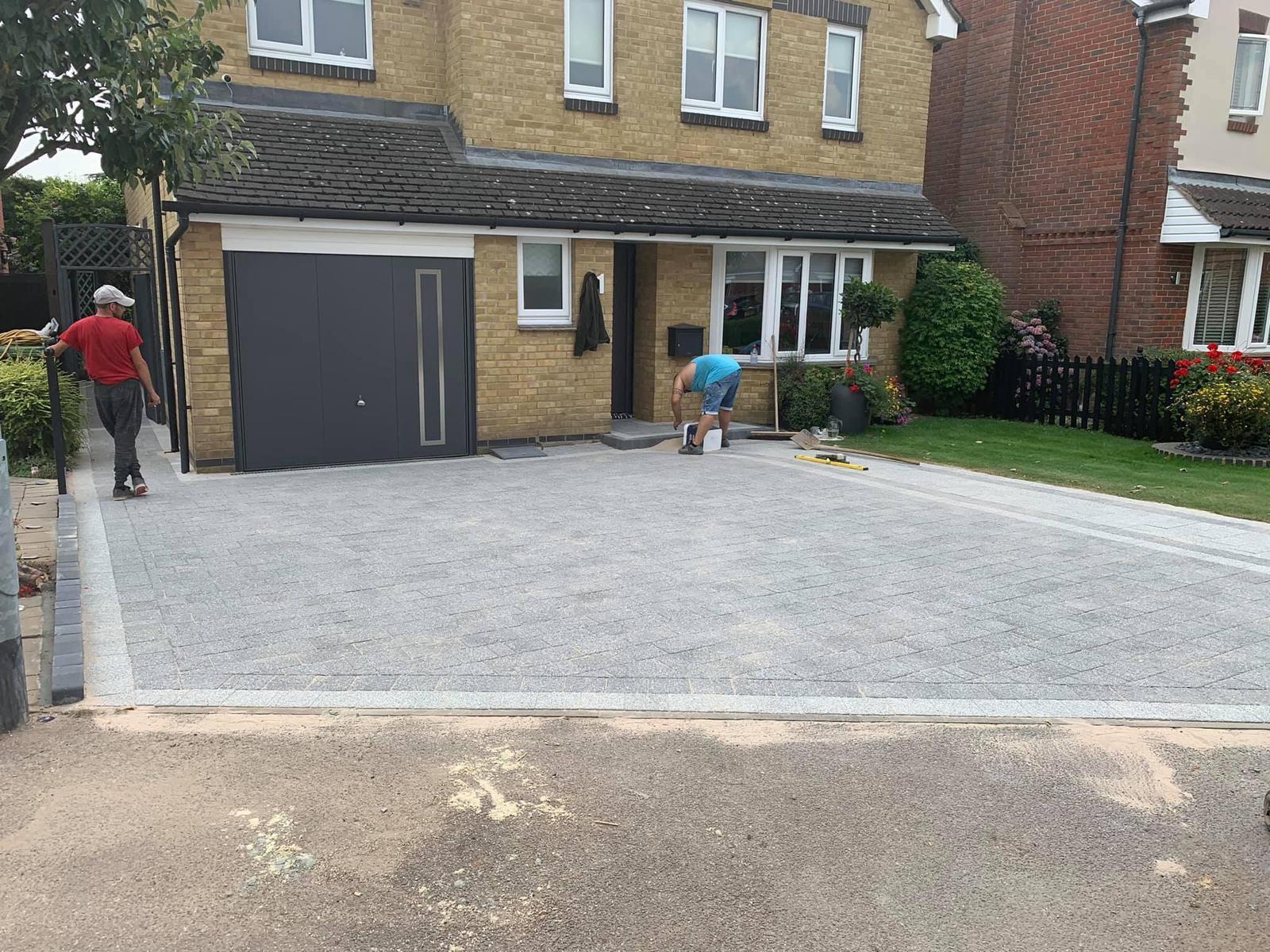
Driveways in Waltham Abbey: The 2026 Quick Answer
Planning a new driveway in Waltham Abbey? Here is the short version. In 2026, a new driveway in the EN9 area typically costs between £2,200 for a small single drive and £9,000 for a large double, depending on material and groundwork. Block paving and resin-bound are the two most popular choices locally, and the single biggest factor in how long any driveway lasts is not the surface, it is the sub-base beneath it, because much of Waltham Abbey sits on moving Lea Valley clay. This guide gives you the real costs, an honest material comparison, the local planning rules, and how to pick an installer who will not cut corners underground.
We install driveways across EN9 every week as established paving contractors in Waltham Abbey, so the figures and advice below reflect what actually happens on local jobs not generic national averages.
Why Waltham Abbey’s Ground Makes Driveways Different
Most driveway failures in Waltham Abbey trace back to one thing: the ground. The town straddles the Lea Valley basin, and the subsoil changes dramatically across short distances. Near the River Lea, the Royal Gunpowder Mills and the western edge of town, the land is silty alluvial deposit and river-terrace gravel, it drains reasonably but shifts under vehicle loading if poorly compacted. Move east toward Honey Lane, Upshire and the Epping Forest fringe and the profile turns to expansive London Clay that swells in wet winters and shrinks in dry summers. You can check the ground beneath your own street on the British Geological Survey viewer.
This seasonal shrink-swell movement is why “builder-grade” driveways laid on a shallow, contaminated base crack, rut and sink within a few years. It is also why a driveway that performs brilliantly on the gravel soils near Sewardstone can fail on the clay near Honey Lane if the same specification is used for both. Every driveway should be engineered for the plot it sits on not to a single fixed depth.
How Much Do Driveways in Waltham Abbey Cost in 2026?
Costs have risen with materials and labour, but they remain predictable when quoted properly. The table below shows typical 2026 fully-installed prices for the EN9 area (including excavation, sub-base, edging and labour). Because Waltham Abbey borders Greater London, local pricing tends to sit at the mid-to-upper end of national ranges reported by industry cost guides such as Checkatrade.
| Material | Cost per m² (2026) | Single drive (~20m²) | Double drive (~50m²) | Typical lifespan |
|---|---|---|---|---|
| Gravel | £40–£70 | £900–£1,600 | £2,200–£3,800 | 10–15 yrs |
| Tarmac | £50–£90 | £1,200–£2,000 | £3,000–£4,800 | 15–20 yrs |
| Block paving | £90–£130 | £2,200–£3,200 | £5,000–£8,000 | 20–25+ yrs |
| Resin-bound | £90–£140 | £2,400–£3,600 | £5,500–£9,000 | 15–25 yrs |
Two things move these figures most: groundwork (removing a failed base, deeper excavation on clay, or new drainage adds cost) and access (tight or terraced properties near Sun Street take longer). Resin-bound can be cheaper as an overlay on a sound existing base (from roughly £85/m²) but rises to £150/m² or more for a full dig-out. A fixed quote after a site survey is the only figure you should rely on beware any price given without one.
Driveway Materials Compared for Waltham Abbey Homes
No single surface is right for every property. Block paving is the local all-rounder: laid in a herringbone pattern it is extremely strong under vehicles, individual blocks can be lifted for repairs, and premium ranges from Marshalls and Tobermore suit both period homes near Market Square and modern estates. Resin-bound gives a seamless, contemporary finish that is naturally permeable and SuDS-compliant, ideal for the damp alluvial ground near the River Lea and for planning-sensitive front gardens, provided it is laid over a proper tarmac or concrete base, never straight onto loose ground. Tarmac is the value option for larger drives along Sewardstone Road, and gravel suits rural and cottage-style plots near Upshire and High Beach with built-in drainage. For a full head-to-head on the two most popular choices, see our guide on block paving vs resin.
The Sub-Base: Why It Decides Whether Your Driveway Lasts
Here is the detail the cheapest quotes hide. On Waltham Abbey’s variable ground, we excavate to a minimum of 250mm–300mm depending on soil and load, then build a structure designed to separate, stabilise and drain. Our specification includes a dual-layer geotextile membrane to keep soft native soil out of the structural base, a 150mm–175mm MOT Type 1 sub-base of crushed granite compacted in layers, drainage falls of at least 1.5%, and reinforced concrete edge restraints to stop lateral spread. This stops the sub-base migrating into silty alluvium near the Lea and resists clay heave on the Epping Forest fringe. A beautiful surface on a poor base is a driveway with a countdown timer, the foundation is the product.
Planning Permission, SuDS & the Epping Forest SAC
Waltham Abbey falls within the influence zone of the Epping Forest Special Area of Conservation, one of the UK’s most protected landscapes, so surface-water runoff and new hardstanding are scrutinised closely. Under permitted development, if your front-garden driveway exceeds five square metres and uses a non-permeable surface that drains onto the public highway, you will usually need planning permission from Epping Forest District Council. National guidance is on the Planning Portal, and habitat detail is on the JNCC Epping Forest SAC record. The simplest way to avoid an application is a fully SuDS-compliant design, resin-bound, permeable block paving, gravel, or drainage to a soakaway rather than the road. We design every driveway to be compliant from the outset, which protects local watercourses and keeps your project moving without council delays.
How to Choose a Driveway Installer in Waltham Abbey
The area has plenty of driveway companies, so use these checks to separate the reliable from the risky. First, confirm they carry public liability insurance and will show it. Second, ask exactly how they build the sub-base, depth, membrane, compaction because that is where corners get cut. Third, look for verified reviews on independent platforms such as Checkatrade or TrustATrader, not just testimonials on a website. Fourth, get a written guarantee on workmanship, not a verbal promise. And finally, be wary of large upfront deposits reputable installers fund their own materials and invoice on completion. We are TrustATrader Vetted and Approved with a 5.0-star rating, fully insured, work on a strict no-deposit basis, use only directly-employed craftsmen (never subcontractors), and back every driveway with a 10-year structural guarantee.
Areas We Cover Across Waltham Abbey & Nearby
We install driveways throughout EN9 and the surrounding West Essex and Hertfordshire border, including Waltham Abbey town centre, Honey Lane, Woodgreen, Sewardstone Road, Sewardstone village, Upshire, Copthall Green, High Beach, Nazeing and Holyfield, plus homes near King Harold Academy and M25 Junction 26. We also serve neighbouring Epping and Cheshunt, along with Hoddesdon and Broxbourne. See recent installations in our project gallery, or pair your driveway with new patios and landscaping for a coordinated finish.
Frequently Asked Questions
How much does a driveway cost in Waltham Abbey in 2026?
Expect roughly £2,200–£3,600 for a single drive and £5,000–£9,000 for a double, depending on material and groundwork. Gravel and tarmac are the cheapest; block paving and resin-bound are premium. Prices include excavation, sub-base, edging and labour, and are confirmed with a fixed quote after a free survey.
What is the best driveway material for Waltham Abbey’s clay soil?
Block paving in a herringbone pattern and permeable resin-bound both perform well, because they tolerate ground movement when laid on a deep, compacted Type 1 base with a geotextile membrane. The material matters less than the sub-base beneath it.
Do I need planning permission for a new driveway in Waltham Abbey?
Not if you use a permeable surface (resin-bound, permeable block paving or gravel) or drain water within your property. A non-permeable surface over five square metres draining onto the road needs approval from Epping Forest District Council.
How long does a driveway installation take?
A standard two-car driveway takes five to eight working days, covering excavation, sub-base, drainage, edging, surfacing and finishing. We confirm a fixed completion date before starting.
Which driveway lasts the longest?
Well-installed block paving lasts 20–25 years or more and is easily repaired; resin-bound and tarmac last around 15–20+ years; gravel needs topping up over 10–15 years. In every case, lifespan depends on the quality of the groundwork.
Do you require a deposit?
No. We operate a strict no-deposit model – you pay nothing until the driveway is complete and you have inspected it – and every job carries a 10-year structural guarantee.
Get a Free Driveway Quote in Waltham Abbey
For an honest, fixed-price quote and expert advice on the right material for your property, book a free site survey today. Call 01992 879 581, 0208 485 6516 or 079 5164 8990, email info@mainlinedrivesandpatios.co.uk, or request your free quote online. We serve Hertfordshire, Broxbourne, Hoddesdon, Cheshunt, Harlow, Epping, Waltham Abbey and all surrounding areas.